How can virtual reality improve neuropsychological assessment? What can VR reveal about attention, executive functions, and memory that traditional testing might miss? In this Nesplora webinar, Dr. Philip Sarpong, clinical psychologist, joins Nesplora’s R&D Manager to explore the practical applications of virtual reality in neuropsychology, drawing on clinical experience, real-world examples, and the possibilities offered […]
Author: Iciar Iturmendi When we talk about attention in ADHD or autism, the conversation tends to swing between two poles: people who “can’t concentrate” and people who focus so intensely they can’t stop. The work of Carleigh Pace-Tonna, a PhD researcher in the Department of Psychology at the University of Toronto and the Centre for […]
Dyscalculia is a specific learning disorder that affects a person’s ability to understand and work with numbers. Often compared to dyslexia (which affects reading), dyscalculia primarily impacts mathematical skills and can significantly affect everyday life. In this article, we explore what dyscalculia is, how it is diagnosed, and what an appropriate intervention should include in […]
Twice-exceptionality involving giftedness and ASD or ADHD presents specific clinical challenges in neuropsychological assessment. Proper identification is essential to develop effective interventions that address both outstanding abilities and associated difficulties. The term twice-exceptionality is not an official diagnostic category—it does not appear as such in the DSM-5 or ICD-11—but rather a clinical concept used to […]
How can we improve the assessment of ADHD beyond traditional behavior-based tools? What role can immersive technologies play in providing a more objective, accurate, and ecologically valid evaluation? And how can we detect real attention problems—rather than environmental or emotional distractions—more precisely? In the webinar “Neurodevelopmental disorders and Modern Assessment Paradigms” clinical psychologist Dr. Christopher […]
Inhibition, which is part of executive control along with cognitive flexibility and working memory, regulates impulses and automatic behavior. In psychology, it is known as inhibitory control, and as part of the executive functions, inhibition plays a fundamental role in regulating automatic responses. What is inhibitory control or inhibition in psychology? In psychology, when talking […]
Brain processing speed and ADHD are closely related because a slow brain processing speed can affect learning, organization and academic performance. In this article, we will explore what brain processing speed is in neuropsychology, its characteristics in people with ADHD and how to effectively assess it. What is brain processing speed? Let’s start by defining […]
Lee este artículo en español The academic community, together with clinical professionals and companies, is dedicated to advancing how ADHD and attention-related challenges are understood and managed. One key area of interest is how children process auditory and visual stimuli—an area that significantly impacts their daily experiences, especially in learning environments. In that sense, the […]
ℹ️ Si quieres leer este contenido en español, haz clic aquí. Attention problems are identified relatively quickly at home and in schools. But are they the source of the problem or a consequence? Why do some professionals fail to diagnose ADHD correctly? What clues does neuropsychological assessment with virtual reality offer to detect whether […]
ℹ️ Si quieres leer este contenido en español, haz clic en este enlace. So far, ADHD diagnosis has mainly focused on two areas: inattention and hyperactivity. However, a group of researchers is shaking up this approach by using virtual reality (VR) technology in their studies. They’ve uncovered new subtypes of ADHD and emphasized the need to […]


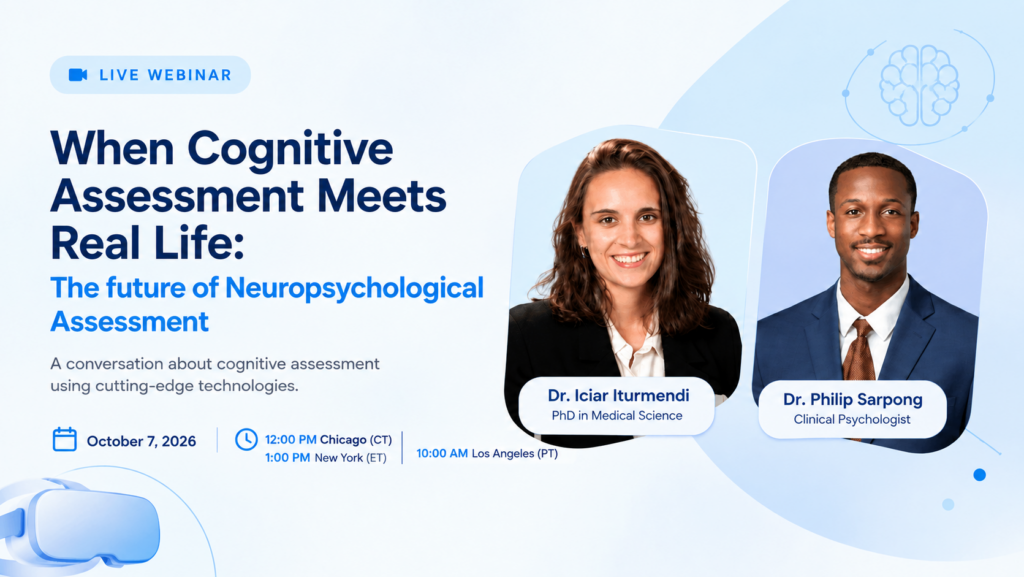 How can virtual reality improve neuropsychological assessment? What can VR reveal about attention, executive functions, and memory that traditional testing might miss? In this Nesplora webinar, Dr. Philip Sarpong, clinical psychologist, joins Nesplora’s R&D Manager to explore the practical applications of virtual reality in neuropsychology, drawing on clinical experience, real-world examples, and the possibilities offered […]
 Author: Iciar Iturmendi When we talk about attention in ADHD or autism, the conversation tends to swing between two poles: people who “can’t concentrate” and people who focus so intensely they can’t stop. The work of Carleigh Pace-Tonna, a PhD researcher in the Department of Psychology at the University of Toronto and the Centre for […]
 Dyscalculia is a specific learning disorder that affects a person’s ability to understand and work with numbers. Often compared to dyslexia (which affects reading), dyscalculia primarily impacts mathematical skills and can significantly affect everyday life. In this article, we explore what dyscalculia is, how it is diagnosed, and what an appropriate intervention should include in […]
 Twice-exceptionality involving giftedness and ASD or ADHD presents specific clinical challenges in neuropsychological assessment. Proper identification is essential to develop effective interventions that address both outstanding abilities and associated difficulties. The term twice-exceptionality is not an official diagnostic category—it does not appear as such in the DSM-5 or ICD-11—but rather a clinical concept used to […]
 How can we improve the assessment of ADHD beyond traditional behavior-based tools? What role can immersive technologies play in providing a more objective, accurate, and ecologically valid evaluation? And how can we detect real attention problems—rather than environmental or emotional distractions—more precisely? In the webinar “Neurodevelopmental disorders and Modern Assessment Paradigms” clinical psychologist Dr. Christopher […]
 Inhibition, which is part of executive control along with cognitive flexibility and working memory, regulates impulses and automatic behavior. In psychology, it is known as inhibitory control, and as part of the executive functions, inhibition plays a fundamental role in regulating automatic responses. What is inhibitory control or inhibition in psychology? In psychology, when talking […]
 Brain processing speed and ADHD are closely related because a slow brain processing speed can affect learning, organization and academic performance. In this article, we will explore what brain processing speed is in neuropsychology, its characteristics in people with ADHD and how to effectively assess it. What is brain processing speed? Let’s start by defining […]
 Lee este artículo en español The academic community, together with clinical professionals and companies, is dedicated to advancing how ADHD and attention-related challenges are understood and managed. One key area of interest is how children process auditory and visual stimuli—an area that significantly impacts their daily experiences, especially in learning environments. In that sense, the […]
 ℹ️ Si quieres leer este contenido en español, haz clic aquí. Attention problems are identified relatively quickly at home and in schools. But are they the source of the problem or a consequence? Why do some professionals fail to diagnose ADHD correctly? What clues does neuropsychological assessment with virtual reality offer to detect whether […]
 ℹ️ Si quieres leer este contenido en español, haz clic en este enlace. So far, ADHD diagnosis has mainly focused on two areas: inattention and hyperactivity. However, a group of researchers is shaking up this approach by using virtual reality (VR) technology in their studies. They’ve uncovered new subtypes of ADHD and emphasized the need to […]