

Author: Iciar Iturmendi
When we talk about attention in ADHD or autism, the conversation tends to swing between two poles: people who “can’t concentrate” and people who focus so intensely they can’t stop. The work of Carleigh Pace-Tonna, a PhD researcher in the Department of Psychology at the University of Toronto and the Centre for Addiction and Mental Health (CAMH) in Toronto, suggests both pictures miss most of what’s going on.
Her research looks at how attentional states fluctuate and are influenced by context and inner thoughts and feelings. We spoke with her about what attentional states characterize autism and ADHD, why it matters to understand them, and what they mean for how we assess and support attention.
Three states beyond “focused” and “distracted”
Flow, often called “being in the zone,” is what Carleigh describes as “a state of deep focus and immersion experienced across many activities.” The term was coined by psychologist Mihaly Csikszentmihalyi, who studied it in the general population as a rewarding absorption in tasks that are challenging but achievable. How flow shows up in autistic and ADHD people, and how it overlaps with or differs from related states, is exactly what researchers like Carleigh are now exploring.
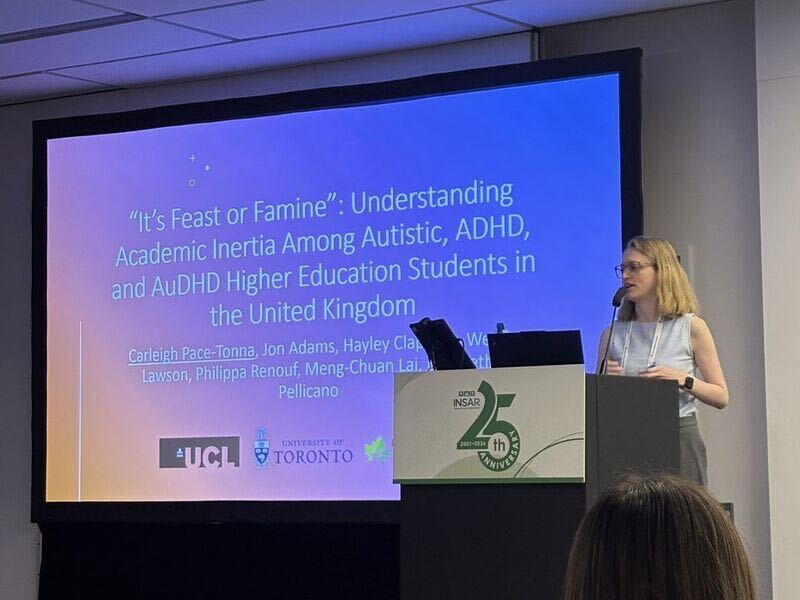
A related concept, inertia, is central to Carleigh’s own work. It refers to difficulty starting or stopping tasks. “Starting can feel like being locked out of a task no matter how much one wants to begin,” she explains, “while stopping once immersed can be just as difficult.”
A recent study in Communications Psychology (Ward et al., 2026), which analysed over 500 Reddit posts by autistic adults, shows what inertia looks like day to day. Users described being unable to “find the trigger” to start, even for tasks they were excited about, and feeling “stuck” or “paralysed.” At the other extreme, some became so absorbed that they went without eating or sleeping. Even switching tasks took effort: “You can’t go from ‘doing the dishes’ to ‘doing the laundry’; you have to go from ‘doing the dishes’ to ‘shifting tasks’ to ‘doing the laundry’.”
Lastly, monotropism is a theory of autistic attention proposed by Dinah Murray, Mike Lesser and Wenn Lawson in 2005. It suggests autistic people tend to channel attention into a few interests at a time, rather than spreading it thinly across many.
Why these states matter
Together, these states show that attention isn’t simply present or absent. That’s the misconception Carleigh most wants to challenge. “It is not just an inability to focus, nor is it constant intense focus,” she says. “It is variable, and numerous contextual and personal factors shape how attention is experienced.”
The effects reach well beyond the classroom. Inertia matters, Carleigh explains, because it shows up “outside academic settings, affecting everyday routines, work, relationships, and rest.” Picture someone who needs to reply to an urgent work email. They know exactly what to write and want to get it done, yet they can’t begin, and hours slip by. Later that evening, deep in a project they care about, they can’t stop: dinner is skipped, a friend’s call goes unanswered, and bedtime comes and goes. In this way, inertia can interfere with people’s ability to manage work, self-care and relationships efficiently.
Attention doesn’t work alone: environment, sensory processing and executive function
Carleigh’s PhD investigates how flow, inertia and monotropism occur in autistic and ADHD people, “looking at what helps or hinders attention, and how understanding these experiences can support wellbeing and lead to more accessible, supportive school and work environments.” Research in this area is still emerging.
The environment is a key thread. She considers “how sensory aspects and task design can facilitate entry into these states.” A student might settle into deep focus in a quiet library corner yet be unable to start in a classroom full of chatter and flickering lights. For someone with heightened sensory sensitivity, managing that background can use up the energy needed to begin. Likewise, a large, open-ended assignment can be hard to enter, while the same work broken into clear first steps, or tied to an existing interest, can open the door to flow.
Executive functions add another layer: the processes that help us plan, hold information in mind, hold back impulses and switch tasks. In the email example, starting depends on planning and breaking the task into steps, while pulling away from the absorbing project calls on cognitive flexibility. A student juggling several spoken instructions may lose track not from inattention but because working memory is overloaded. Interest and urgency matter too, which helps explain why the same person can be absorbed one hour and stuck the next.
Start with the person
Because attention varies so much, strategies do too. “Strategies are similarly inconsistent,” Carleigh says, “and something that works one time might not work next time. A single approach cannot be applied to everyone.”
Carleigh’s advice to teachers, families and other professionals is to work closely with each individual. “It is important to get to know the individual and develop supports that are tailored to their needs.”
Her interest in attentional states began with listening. As an undergraduate, she worked as a peer facilitator in her university’s accessibility services, supporting autistic and ADHD students. “Hearing their experiences, alongside my own time navigating academia, helped me see where the gaps are,” she says.
She also saw how damaging it can be when students go unaccommodated: it “can harm self-esteem, reduce interest in school, and often leads students to blame themselves for not fitting into a system that was not designed for them.” Her time in accessibility services also left a hopeful lesson: “The supports that help these students often benefit others as well.”
What CPTs can and can’t tell us
The same principle applies to assessment. Asked how well continuous performance tests (CPTs), like Nesplora’s AULA, and informant-report scales capture real-world attention, Carleigh is balanced. “I believe these measures are valuable and capture different important aspects of attention,” she says. “That said, we should be cautious about relying on any single measure to capture attention as a whole.”
In her view, these measures are strongest “when used alongside other tools, including qualitative approaches such as asking individuals directly about their experiences.” Factors like sensory load, autonomy and personal goals are difficult to capture through traditional measures, so “engaging in discussions with the individual is a valuable way to understand their unique attentional profile.”
Why the work matters
For Carleigh, the most rewarding part is “hearing how this work has helped others.” Many participants have thanked her, she says, “because attention shapes so many aspects of their lives. They want to better understand their own experiences and find strategies that work for them.”
Her hope is that the research will contribute to a better understanding of neurodivergent attention and, ultimately, “help people have more positive experiences and greater control over how they manage their attention.” As she puts it, “There is important research being done in this field,” and it’s a conversation that clinicians, educators and families all have a stake in.
Where Nesplora’s tests fit
That shared stake is where Nesplora’s tests come in. AULA, a virtual-classroom CPT for children and adolescents, goes beyond omissions and commissions to show how attention holds up with and without distractors and how reaction times vary across the session: the kind of fluctuation Carleigh describes. Its family report turns the child’s attentional profile into practical ideas for support at home, at school and in other everyday settings, putting into practice Carleigh’s call to tailor supports to the individual and giving families a starting point for those conversations.
For adults, Aquarium assesses attention alongside the executive functions it relies on. Beyond sustained attention and response consistency, it measures inhibitory control, working memory under dual-task conditions, and switching, including perseverative errors. Because attention doesn’t work alone, this shows how it holds up as a task’s executive demands change, such as holding several things in mind or shifting between rules.
Ice Cream adds a broader look at planning, working memory and cognitive flexibility, set in a virtual ice cream parlour.
None of these tests measures flow or inertia directly or is diagnostic on its own. They add objective data to clinical judgement, alongside interviews, rating scales and, as Carleigh reminds us, the person’s own account of their attention.
Our thanks to Carleigh Pace-Tonna for sharing her time and insights.
References
Pace-Tonna, C., Murtaza, M., Rodak, T., Farb, N., Ryan, W., & Lai, M.-C. (2026). Flow and Similar Attentional States in Autism and ADHD: A Scoping Review of Similarities and Differences. Perspectives on Psychological Science, 0(0). https://doi.org/10.1177/17456916261470783
Pace-Tonna, Carleigh Alyssa, et al. “Flow and Similar Attentional States in Autism and ADHD: A Scoping Review of Similarities and Differences.” INSAR 2025 (2025).
Climent, G. (Ed.). (2018). Attention Adults Aquarium: Manual. Nesplora, Technology & Behavior.
Climent, G., Rodríguez, C., García, T., Areces, D., Mejías, M., Aierbe, A., Moreno, M., Cueto, E., Castellá, J., & González, M. F. (2021). New virtual reality tool (Nesplora Aquarium) for assessing attention and working memory in adults: A normative study. Applied Neuropsychology: Adult, 28(4), 403–415. https://doi.org/10.1080/23279095.2019.1646745
Climent, G., & Tirapu, J. (2022). Executive Functions Ice Cream: Manual (1st ed.). Giunti-Nesplora.
Csikszentmihalyi, M. (1990). Flow: The psychology of optimal experience. Harper & Row.
Mulchay, C., Goller, H., & Rice, W. (2024). Virtual reality-based attention test review: The Nesplora Aula. Journal of Pediatric Neuropsychology, 10(3), 243–249. https://doi.org/10.1007/s40817-024-00161-z
Murray, D., Lesser, M., & Lawson, W. (2005). Attention, monotropism and the diagnostic criteria for autism. Autism, 9(2), 139–156. https://doi.org/10.1177/1362613305051398
Ward, T., Popazov, S., Adams, J., Clapham, H., Lawson, W., Karaminis, T., & Pellicano, E. (2026). Understanding phenomenological experiences of autistic inertia using online community discourse. Communications Psychology, 4, Article 18. https://doi.org/10.1038/s44271-025-00386-4